The North American cougar (Puma concolor couguar) has lived across much of North America. It used to roam from western Canada and the U.S. to Mexico and Central America. Some even made it into South America, just northwest of the Andes Mountains.
Its range in the east lessened because of humans, but the cougar stays common in the west. Recent sightings and DNA from the environment show they live in more places than we thought. They’ve been seen in places like New Brunswick, Ontario, and Quebec in eastern Canada. This shows they cover a larger area than we guessed.
Introduction to the North American Cougar
The North American cougar, known as Puma concolor couguar, is truly remarkable. It is the largest cat in North America, dominating its ecosystems. This apex predator plays a vital role in keeping these environments in balance.
Scientific Classification
In the scientific world, it belongs to the Felidae family, with the name Puma concolor couguar. This name helps us know it’s unique among wild cats due to its special features and where it lives.
General Description
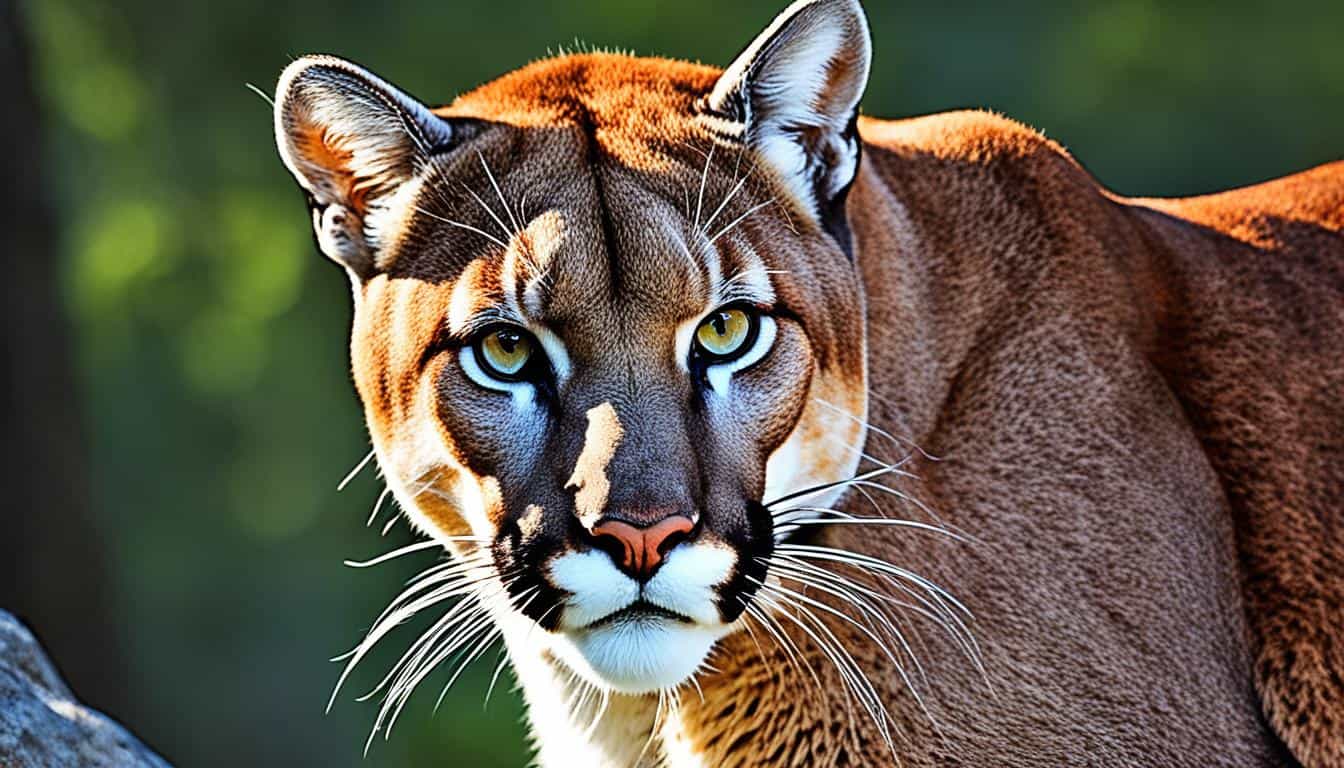
The North American cougar is unique in many ways. It has a tan coat that sets it apart from other wild cats with spots. This big cat weighs between 55 and 176 pounds (25-80 kg). Females are around 110 pounds (50 kg), which is similar to jaguars in Mexico. These big cats are strong and adapt well to different environments.
Over time, how we classify North American cougars has changed. In 2017, the Cat Specialist Group recognized it as a unique subspecies. Even with challenges from the environment, these big cats show they are tough and can adapt well.
Past and Present Distribution
The historical range of cougars was vast, including the whole of eastern North America. By the early 20th century, it was thought that cougars were gone from these parts. This happened because homes and roads spread, and people hunted them a lot.
Historical Range
Cougars lived in many places, from the dense Appalachian forests to the wide plains. They were an important part of the regional nature. But, hunting and building changed things, and their numbers got really low. People believed they were almost gone from the east.
Modern Day Distribution
Today, cougars are found in the western United States, some parts of Southern Florida, and western Canada. Though thought to be gone from the east, there is new evidence. This evidence shows that small groups might still be in places like the Appalachian Mountains and eastern Canada.
This new way of living for cougars shows how they can survive and change over time.
The finding of small cougar groups in the east is very important. It shows why it’s vital to keep studying and protecting them. This ongoing research helps us make plans for saving them and living alongside them as we develop.
North American Cougar Habitat
The North American cougar does well in many places, like mountains, forests, and deserts. It’s good at living in various environments. This shows how tough and flexible they are.
Types of Habitats
They can live in mountains, dense forests, and dry deserts. Each place gives them new challenges and chances to thrive. In mountains, they find dens and hunting spots in rocky areas. Their climbing skills are unmatched.
In forests, cougars hide easily in the cover for hunting. But the deserts really test their survival skills. They have to get creative to find water and shade.
Cougars play a big role in the ecosystem by keeping the herbivore population in check. They stop these animals from eating too much plant life. This helps many other plants and prey animals live, making the ecosystem diverse and strong.
Cougars are even learning to live near us. They’re adapting their ways to deal with new dangers from people. Their huge territories show they can find new places to live and hunt, no matter what signs of people are there.
Knowing about where North American cougars live and how they adapt is key to saving them. By understanding their place in nature, we can help protect them and the land they live on.
What is the range of the North American cougar?
The North American cougar’s range is quite impressive. It spans from the western Canadian provinces to many western states of the U.S. It then goes down through Mexico and Central America. It even reaches South America, north of the Andes Mountains. In some regions like the eastern U.S., sightings are very rare. These rare sightings are key for understanding how many cougars there are and where they live.
| Region | Confirmed Cougar Sightings |
|---|---|
| Western Canada | Frequent |
| Western United States | Common |
| Eastern United States | Rare |
| Mexico | Common |
| Central America | Moderate |
| Northwest South America | Moderate |
Distribution in the United States
In the United States, you’ll find cougars more often in the West. The Eastern part has fewer but still some. They usually live in the wild, away from people.
Western United States
The West is where you see most cougars. California alone may have 4,000 to 6,000 of them. This shows they’re a big part of the area. You might come across these beautiful cats if you’re lucky, and sometimes they cross paths with cars.
Eastern United States
It’s not as common to see cougars in the East. Every now and then, people spot one that’s far from where most of them live. This could mean they travel or stay hidden, unlike in the West where they seem more at home.
States with Confirmed Sightings
Even in the East, places like Michigan and Connecticut have seen cougars. This tells us they might be around more locations than we thought. Seeing them in these places shows how wide their reach is.
| Region | States | Population Estimate |
|---|---|---|
| Western United States | California, Colorado, Utah | High (Thousands) |
| Eastern United States | Michigan, Illinois, Connecticut | Low (Individuals) |
Distribution in Canada
The North American cougar in Canada is spread across various provinces. It is mainly in Western Canada, in places like British Columbia and Alberta. But now, it’s clear they also live in Eastern Canada.

Studies and sightings show cougars in Ontario, Quebec, and New Brunswick. This surprise finding challenges the idea they were gone from these places. It adds to our understanding of Canadian cougar populations.
Here is a list of provinces where cougars have been seen:
| Province | Status |
|---|---|
| British Columbia | Confirmed Presence |
| Alberta | Confirmed Presence |
| Ontario | Confirmed Presence |
| Quebec | Confirmed Presence |
| New Brunswick | Confirmed Presence |
These discoveries change what we know about the North American cougar in Canada. They show why researching these animals’ range is so essential. It helps us see how they live and adapt across the country.
Distribution in Mexico and Central America
The North American cougar spreads into Mexico and Central America, known as Puma concolor couguar. This part looks at their numbers and where they live in these areas.
Mexican Populations
Cougars in Mexico live in many places, from dry deserts to green forests in the mountains. They are well-known in the Chamela-Cuixmala Biosphere Reserve, with plenty of other wildlife around. Their ability to live in different places in Mexico helps them stay strong in these areas.
Central American Populations
South into Central America, cougars are seen living in various places, like in Costa Rica. They can be found in rainforests, cloud forests, and along the coast. This shows how well they adapt to different homes, helping keep nature balanced despite human activity and changes in their living spaces.
| Region | Habitat Type | Population Status |
|---|---|---|
| Mexico | Deserts, Mountains | Stable |
| Costa Rica | Tropical Rainforests | Thriving |
| Guatemala | Cloud Forests | Stable |
Cougar Territories and Home Ranges
Cougars show interesting behavior when it comes to their living spaces. They establish territories, marking the boundaries clearly. This helps avoid conflicts and ensures they have their own space. This knowledge is key to protecting these stunning animals.
Male Territories
In cougars, males have large territories. They can cover between 50 to 150 square miles. They do this to find mates and resources, and to show they are the boss. They check their areas often to make sure no other males invade.
Female Territories
Female cougars, however, claim smaller territories. It’s not just about space; these areas are important for raising their young and finding food. Their living areas may mix with male cougars’, making it easier to find a mate. But what’s interesting is that females can share parts of their space. This is especially true when it comes to their daughters.
Factors Affecting Distribution
The range and population of the North American cougar depend on several factors. The most important are its conservation status and human activities. Each U.S. state has different rules for protecting cougar populations. For example, in California, they are “specially protected,” so you can’t hunt them for sport. On the other hand, Texas treats cougars as a “varmint,” which means they can be killed without limit. These rules greatly influence where the cougars are found and how many there are.
Conservation Status
Conservation status is key for the North American cougar. For subspecies like the Florida panther, which are endangered, protection is critical. The Florida panther is among the world’s most endangered mammals. Strict measures are required to keep these species from disappearing. Good conservation helps stabilize or grow cougar territories. Yet, without enough protection, their numbers can fall, and their homes can get split up.
Human Impact
Human effects are the biggest danger to cougars. Hunting and loss of home because of towns growing are major issues. Hunting for sport, especially where it’s easy, can lower cougar numbers. Also, as cities grow and forests are cut down, cougars lose places to live, find food, and raise their young. To deal with these challenges, we need to focus on our part in having a safer world for cougars. This means making strong rules for conservation and teaching ways to share our spaces with wildlife.
FAQ
What is the range of the North American cougar?
The North American cougar roams from the western Canadian provinces through the United States. It covers nearly every western state. The range also stretches southward into Mexico, Central America, and parts of South America.
What is the scientific classification of the North American cougar?
The North American cougar is part of the Puma concolor couguar species. It’s in the Felidae family. This classification has been valid since 2017, recognized by the Cat Specialist Group.
Can you describe the general appearance of the North American cougar?
The North American cougar has a solid tan coat. It’s the largest cat in North America. Adult cougars weigh between 25 and 80 kg, with an average female weight of about 50 kg. They don’t have the spots you see on other wild cats.
What was the historical range of the North American cougar?
In the past, the North American cougar lived across the eastern part of the continent. Yet, by the early 1900s, many had disappeared from the East. This loss was due to hunting and loss of habitat caused by human activities.
What is the modern-day distribution of the North American cougar?
Today, you’ll mostly find cougars in the western U.S. and parts of Canada. Some have also been spotted in the East, in places like New Brunswick, Ontario, and Quebec.
What types of habitats does the North American cougar inhabit?
The North American cougar can adapt to many settings. It lives in mountains, forests, and even deserts. They often make dens in rocky areas or thick vegetation.
Where is the North American cougar found in the United States?
In the U.S., you’ll see cougars mainly in the West. They’re most common in states like California. There, it’s estimated there are between 4,000 to 6,000 of them. Occasionally, they’re seen in the East too, like Michigan, Illinois, and Connecticut.
What is the distribution of the North American cougar in Canada?
In Canada, cougars are found out West, in places like British Columbia and Alberta. They’ve also been seen in the East, in provinces like Ontario, Quebec, and New Brunswick. This means their range in Canada is wider than first thought.
How is the North American cougar distributed in Mexico and Central America?
In Mexico, cougars are doing well, especially in places like the Chamela-Cuixmala Biosphere Reserve. They’re also seen in Central America, including countries like Costa Rica. This shows they can live in many different environments.
What are the territorial behaviors of the North American cougar?
Male cougars claim territories that can be as large as 150 square miles. Females have smaller territories. These areas are vital for hunting and raising their young. Males can mate with several females but often don’t help raise the cubs.
What is the conservation status of the North American cougar?
In the U.S., cougar protection varies. In California, they’re a “specially protected mammal,” so hunting them is not allowed. In Texas, they’re considered a “varmint,” which means they can be killed without restrictions. The Florida panther, a type of cougar, is endangered. Efforts to protect them face challenges from hunting and loss of habitat.