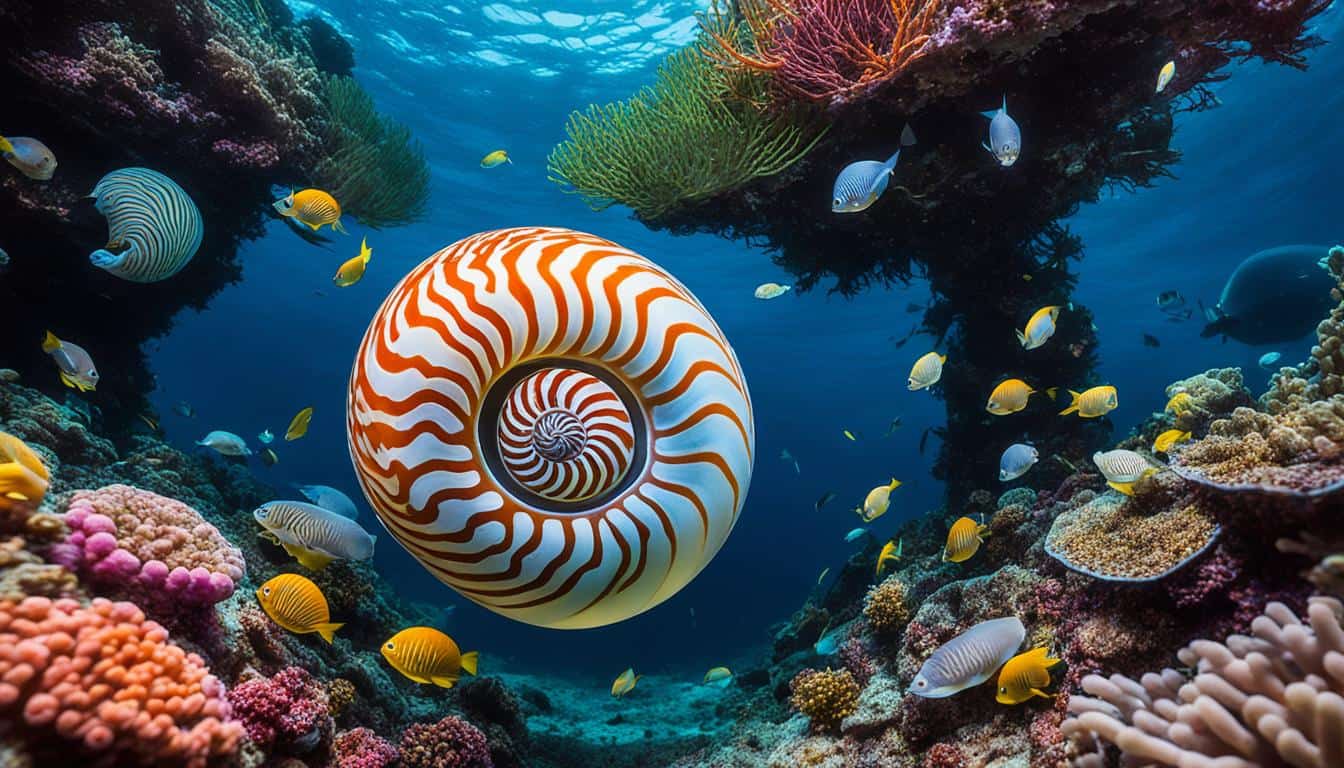
Nautiluses are often seen as living fossils because they have been around for so long. They have special abilities that help them live deep in the ocean. You might be curious about how they find their way around underwater.
Nautiluses have a unique shell with chambers that help them control their buoyancy. This is key to their navigation as they move through the ocean. Their movements show how well they have adapted over millions of years.
We will explore how nautiluses navigate in this section. We’ll look at their anatomy and the skills they use to move underwater.
The Anatomy of the Nautilus
The nautilus shows us the beauty of marine life with its unique anatomy. Its design is key to its survival and ability to live deep in the ocean. The shell is a standout feature, helping with buoyancy and keeping predators away.
The Unique Shell Structure
The nautilus has a coiled shell with over 30 chambers that work together. Each chamber helps with staying buoyant, with the outer one being home to the creature. The inner chambers can change buoyancy, letting the nautilus move through different depths smoothly.
This special shell is more than just pretty. It’s crucial for the nautilus to live in various ocean places.
The Role of the Siphuncle
The siphuncle is a key part of the nautilus. It’s a tube of tissue that runs through the shell. This tube helps with gas and liquid exchange, making it easier to change buoyancy.
By controlling gas and water in the chambers, the siphuncle helps the nautilus go up or down. This shows how advanced the nautilus’s body is, letting it live in the changing ocean.
How do nautiluses navigate?
Nautiluses show amazing skills in moving through the ocean. Their unique way of moving helps them survive under water. By learning how they move, we can see how they live in different ocean areas.
Understanding Nautilus Movement Patterns
Nautiluses mainly use jet propulsion to move. They push water out of their chambers to glide through the water. This lets them move quickly backward and change direction fast.
This way of moving helps them avoid dangers and catch food easily.
The Importance of Buoyancy Control
Being able to control their buoyancy is key for the nautilus. They use a special part called the siphuncle for this. This lets them go up and down in the water to find food safely.
Being good at controlling buoyancy makes them better at moving underwater. It shows how they’ve adapted to life in the ocean.
Nautilus Behavior and Navigation Skills
Nautiluses show amazing behaviors that help them navigate the ocean. They move underwater in many ways, making them successful in different marine places. Living on the ocean floor, they use special strategies to move around. These strategies make them stand out from other sea creatures.
Underwater Movement Techniques
Nautiluses use jet propulsion and adjust their buoyancy to move underwater. These methods let them check out coral reefs and live in their environment. They also use slow gliding and active jet propulsion, showing how flexible they are. Here are some key techniques they use:
- Jet Propulsion: Rapid water expulsion for quick movement.
- Buoyancy Control: Adjustments in body gas levels to ascend or descend.
- Gliding: Slow, energy-efficient movement across the ocean floor.
Use of Chemical Cues in Navigation
Nautiluses are more sensitive to chemical cues than many other cephalopods. This helps them find food and move through their home. They can detect chemical signals in the water to find prey or avoid dangers. This shows how they use chemical information to help with their navigation.
Nautilus Spatial Orientation
Nautiluses have amazing skills in spatial orientation. They can move through the underwater world with ease. They are experts at moving up and down in the water column.
Vertical Movement in the Water Column
The nautilus moves up and down using a special method. They change the gas and liquid in their buoyancy chamber. This lets them go up or down without much effort.
This way, they can find food and save energy. It shows how well they adapt to different places under the sea.
Orientation to Ocean Currents
Nautiluses need to know about ocean currents to get around. They use their senses to find and use these currents. By moving with the currents, they improve their hunting and get better at finding their way.
The Role of Eyes in Nautilus Navigation
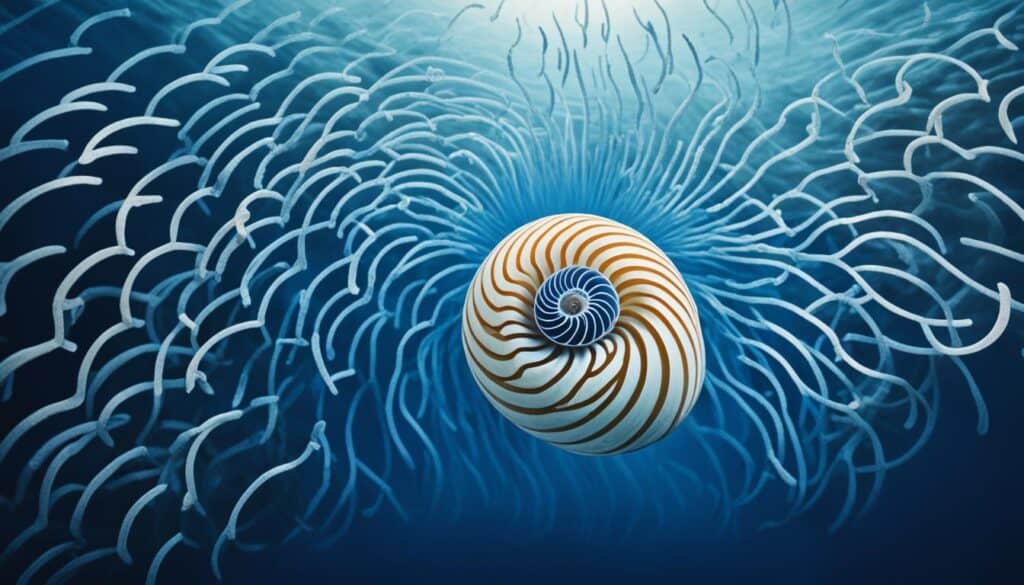
The nautilus has special ways of seeing, different from other cephalopods. When we look at the nautilus’s eyes, we see how they help it move through the water. These special eyes show how nautiluses and other cephalopods have changed over time.
Comparative Analysis with Other Cephalopods
Nautilus eyes are quite different from those of squids and octopuses. Those creatures have complex eyes with lenses for sharp vision. But nautilus eyes are simpler and don’t see as clearly. This shows how different creatures have adapted to their environments.
Limitations of Nautilus Vision
Nautiluses don’t rely much on their vision to find their way. Their eyes are simpler, so they don’t see as well as other cephalopods. Instead, they use smells to navigate the ocean. This shows how they’ve adapted to their own special way of living underwater.
Natural Navigation Methods of Nautiluses
Nautiluses have amazing ways to navigate their world. They use ocean features like temperature and salinity changes, and underwater shapes. These help scientists understand where they live and move.
Understanding Oceanographic Features
Nautiluses rely on ocean features to navigate. They feel changes in water currents and temperature. This helps them find food, avoid dangers, and mate. Their ability to sense these changes is key to their survival.
Fossil Records and Evolutionary Insights
Fossils tell us about nautiluses’ evolution and how they’ve changed over time. They show a long history of adapting to ocean changes. By studying these changes, we learn how nautiluses have stayed alive through different times, giving us a peek into their evolution.
FAQ
How do nautiluses navigate through the ocean?
Nautiluses use a mix of buoyancy control and special movements like jet propulsion. They adjust their position in the water to find food and avoid predators.
What role does the siphuncle play in nautilus navigation?
The siphuncle is key for the nautilus. It helps control buoyancy by managing gas and water in the shell chambers. This lets the nautilus move up or down in the ocean.
How do nautiluses use chemical cues for navigation?
Nautiluses don’t rely much on sight like other cephalopods. They use chemical cues to find food and navigate. This shows their unique ways of adapting.
What are the movement patterns of nautiluses?
Nautiluses move in complex ways, mainly using jet propulsion for backward motion and quick turns. They also move on the ocean floor, using buoyancy for vertical movement.
How does buoyancy control assist in nautilus navigation?
Buoyancy control is crucial for nautiluses. It helps them stay at certain depths for finding food or avoiding predators. The siphuncle helps adjust their buoyancy, making their navigation more efficient.
What techniques do nautiluses employ for underwater movement?
Nautiluses mainly move by jet propulsion and swimming on the seabed. They use buoyancy to explore different depths and navigate underwater landscapes.
How do nautiluses orient themselves within ocean currents?
Nautiluses can orient themselves with ocean currents. This helps with their navigation and finding food. It also saves energy while they move.
What limitations exist in nautilus vision compared to other cephalopods?
Nautiluses have simple eyes that aren’t as sharp as those of octopuses and squids. They use chemical cues more than vision for navigating and hunting.
How do nautiluses utilize natural navigation methods?
Nautiluses use natural ways to navigate, like understanding ocean features and their surroundings. Fossils show how they’ve adapted and navigated the ocean over millions of years.