Wolves have decent claws on their front and back feet – 4 on each foot – with the possibility of 2 spares: the dew claws. Their claws are also called nails though.
Do Wolves Have Claws Or Nails?
Actually Both. A wolf’s claws are made of a material called keratin – which is a type of fibrous protein structure. This is the same material that our human fingernails are made out of so they are often just called ‘nails’ too. Just like our own fingernails – a wolf’s claws are continually growing and wear themselves down over time running on hard surfaces.
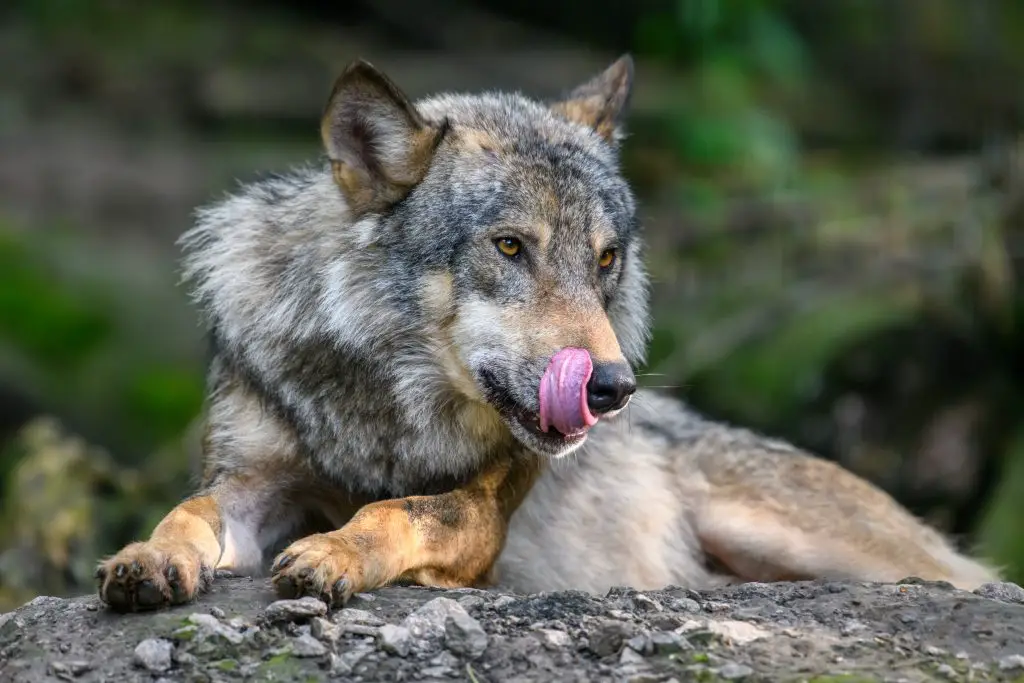
Unlike the claws of a cat – which are fully retractable into their feet – wolves’ claws are not. Their claws stay stuck out on the feet and are always visible. As their nails are kept exposed and stay in contact with the ground at all times – they are not razor sharp like cats. As a result, they are not used to help kill prey in the same way – although they can still scratch you of course.
Wolves simply use their giant sharp teeth to kill their prey instead.
What Does It Mean When Wolves Tap Their Feet?
Wolves exhibit squirrel foot tapping behavior demystified when they are alert and focused. This action involves tapping their feet rapidly on the ground to express excitement or anticipation. It is a non-aggressive behavior commonly observed during hunting or when they encounter something intriguing. The rhythmic tapping helps them communicate with their pack members and coordinate their next move effectively.
Why Do Wolves Need Claws?
Wolves still need their claws though – even though they aren’t sharp. Their claws are narrow points of focus to help grip the loose ground while running. Wolves often cross or run alongside river channels, over mountains, and through canyons – and these sharper points on their feet can help them keep their balance. They are also great for changing direction more easily – especially as there is a mild webbing effect between their toes. This helps spread out the weight on the foot as it turns – increasing control.
These claws can also help to sink slightly into the firmer ground – like crampons – helping a wolf to use less energy when running behind their prey. While out hunting and pacing behind their prey, these claws stabilize their contact with the ground, giving them a more powerful forward motion for less energy spent. Some hunts can have them running a mile or two – so the more energy they can save with clever claws is always a bonus.
They also use their claws for a variety of other things including digging their all-important den for their young. Wolves live in packs of between just 2 (the Alpha couple) and up to 30 other wolves – almost all their own offspring from previous years. This means they need a big, secure den for their shared litter – and it needs constant improvements and extensions to keep them safe.