Do you think there are colorful Green Iguanas freely moving in the United States? It’s true. These amazing reptiles live in places like Florida, Hawaii, Texas, and the US Virgin Islands.
They came from South Mexico, through Central America, to Brazil. Green Iguanas, also called Iguana iguana, arrived in the US as early as 1966. Their journey into the wild started in Miami, Florida. So, how did they get here?
The pet trade played a big role. Because they can grow very big—males up to 6 feet long and 17.5 pounds—some people let them go rather than keep them. Despite preferring warm weather, they now live in certain parts of the US. This has led to some worries about the environment.
Introduction to Iguanas in the USA
Green iguanas have been part of the USA for many years now. They are found in different states, living and growing. These American iguanas eat plants and have become a threat to local plants and animals.
History of Iguanas in America
The story of green iguanas in the USA starts with the pet trade. They come from Central and South America, and the Caribbean. Here, they found places to live and multiply, especially in the warm states.
Populations in Various States
In today’s USA, there are many iguanas in places like Florida. They live in the wild and cities alike, but this is not good for the local environment. The Miami blue butterfly and Florida Burrowing Owl are particularly affected by iguanas, showing the harm they cause.
Green Iguanas: The Most Common Species
The Green Iguana is widespread in the United States. They stand out because of their bright colors and ability to live in many places.
Physical Characteristics of Green Iguanas
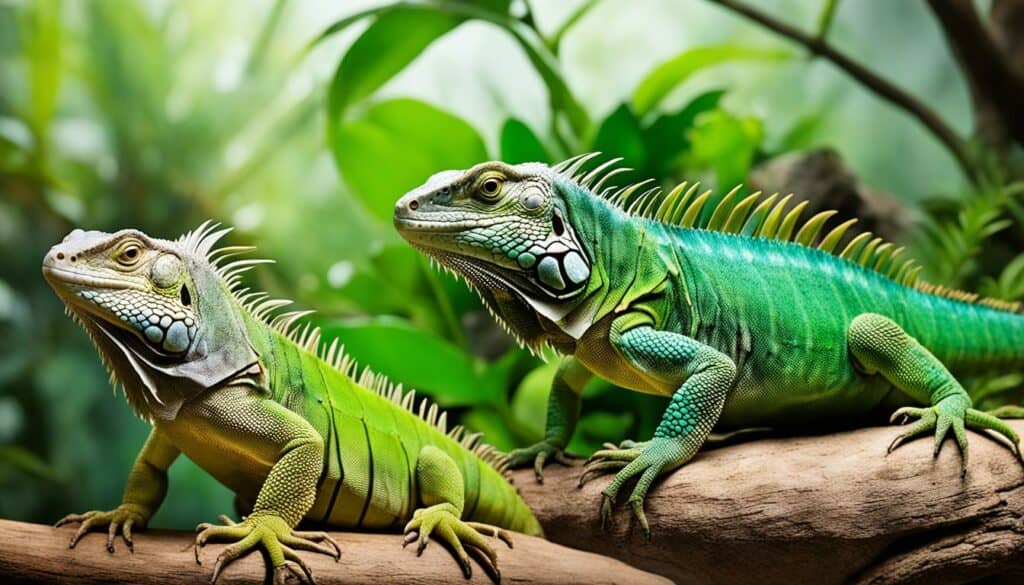
Green Iguanas come in many colors, from bright green to darker shades, which change with age. They have a row of spines down their back and a big dewlap under their chin.
These help them stay the right temperature and talk to each other.
Behavior and Habitat Preferences
Green Iguanas are tree-dwellers and like to be near water. They eat only plants and fruits. Their ability to live in different places makes them stand out among native US iguanas.
They prefer making nests underground to lay their eggs. This increases their chances of survival in the US.
“The Green Iguanas’ ability to adjust its habitat and diet is key to its success and abundance in regions of the United States.”
In places like Florida, you can see how they’ve spread. Their skills and strength have made them very interesting to scientists and those who love reptiles.
Are there wild iguanas in the USA?
Yes, the USA has wild iguanas. They are mostly in places like Florida, Texas, and Hawaii. These wild Green Iguanas are doing well in the warm, subtropical areas. They got there through the pet trade and by finding homes in the local environment.
Green iguanas have found a good fit in the USA’s warm spots. They breed easily and love to soak up the sun. This sunning helps them stay just the right temperature. This shows how strong and adaptable they are in new places.
While the US isn’t their original home, iguanas are thriving in spots like Florida. They show how well they can adjust to new homes. Yet, their increasing numbers mean we need to watch and care for them. We must do this to protect our local plants and animals.
Native vs. Introduced Iguana Species
The United States has many iguana species, with most of them coming from other places rather than being native. The Green Iguana is the most common one here. It has spread a lot due to the pet trade. These iguanas have made new homes and families in the U.S. after being released or running away.
The growing number of iguanas in the U.S. is changing the local areas. These American iguana species from other places quickly have babies. They are good at living in different kinds of places without many dangers. This puts a lot of stress on the plants and animals that were already there.
Some, like the Green Iguana, can live almost anywhere, from cities to forests. The differences between these new species and the ones already here are very important. Knowing these differences helps deal with the problems they cause for the environment.
| Characteristic | Introduced Iguanas | Native Wildlife |
|---|---|---|
| Reproduction Rates | Rapid | Moderate |
| Predator Presence | Minimal | High |
| Environmental Adaptability | High | Varies |
| Impact on Ecosystem | Significant | Balanced |
The fast increase in the U.S. iguana population shows the need for good ways to manage them. Learning about how these new iguanas are different from the ones that belong here can help us deal with the issue. This way, we can better protect the environment from the effects of these fast-breeding reptiles.
The Impact of Iguanas on Local Ecosystems
Green iguanas are causing big problems in places like Florida and Puerto Rico. They are spreading and changing local ecosystems a lot. These changes affect other animals and plants in many ways.
Effects on Native Wildlife
Wild iguanas in the United States are tough competition for local animals that eat plants. They eat so much they push some local plant-eating animals out. The Miami blue butterfly is having a hard time because the iguanas are eating the plants the butterfly needs to live.
Invasion and Ecological Threats
Green iguanas also disrupt local animals by using their homes. They cause issues for the Florida Burrowing Owl. Owls can’t find good spots for nesting and safety because iguanas are taking over. This is a serious ongoing problem that needs to be addressed.
| Impact | Affected Species | Region |
|---|---|---|
| Consumption of Host Plants | Miami Blue Butterfly | Florida |
| Competition for Burrows | Florida Burrowing Owl | Florida |
Geographical Distribution of Iguanas in the USA
Wild reptiles in America have discovered their perfect spots for thriving. Iguanas, especially, have adapted well and spread in North America. They are known for their ability to live in many places, creating large groups in different states.
States with Established Populations
In the USA, you see more iguanas in the south. Places like Florida and Texas stand out for their iguana populations. Don’t forget about Hawaii and the US Virgin Islands; they also have a lot of these reptiles. This shows how widespread they are across the country.
Habitats and Environmental Adaptations
Iguanas are tough and can live in many spots. They are spotted in busy cities and quiet, natural areas like the Everglades. Their impressive ability to live in different places has helped them spread far. This explains why they are found in so many places, surviving and thriving.
Green Iguanas in Florida: An Ongoing Issue
The Green Iguanas in Florida problem dates back several decades. They’re not from here but have made themselves at home. Their invasive ways and the harm they do are a big issue.
Historical Introduction and Spread
It started with selling Green Iguanas in the pet trade. Many were let go by their owners or escaped by accident. This happened a lot in South Florida. The warm weather there is perfect for them.
Current Challenges and Management
Dealing with these invasive iguanas in Florida is tough. They mess up homes and businesses by digging and nesting. They’re also bad for local animals because they fight over food and homes.
Trying to control the number of Green Iguanas in Florida is a team effort. The state is working hard with the public to remove them and educate people. But the iguanas are hard to stop.
| Impact | Description |
|---|---|
| Infrastructure Damage | Burrowing and nesting actions that weaken structural foundations. |
| Ecological Threat | Competition with native species for food and habitat, disrupting local ecosystems. |
| Pet Trade Contribution | Released or escaped pets becoming part of the wild population. |
| Management Strategies | Public awareness, removal programs, and policy implementations. |
Iguanas in Hawaii: A Growing Concern
Iguanas in Hawaii are causing a big problem. They reproduce fast and can live in many places. This is hard for Hawaii’s natural environment. Keeping their numbers down is key to protecting Hawaii’s unique ecosystem.
Regulations and Control Measures
Hawaii is taking steps to deal with iguanas. They are working on changing where iguanas can live. They are also using things to make iguanas not want to stay in certain areas. It’s important that people keep iguanas as pets safe so they don’t let them go outside.
Comparison with Other Invasive Species
Iguanas are like other invasive species in Hawaii. To deal with them, the methods are often the same. This includes trying to lower their number and stop them from hurting the environment.
| Aspect | Iguanas in Hawaii | Other Invasive Species |
|---|---|---|
| Habitat Modification | Implemented to reduce iguana habitat | Used for animals such as feral pigs |
| Deterrents | Applied to discourage iguanas from settling | Employed to prevent establishment of species like rats |
| Regulations | Strict rules for pet owners to avoid releases | Similar regulations for animals like snakes |
Managing iguanas in Hawaii needs a lot of work. This work is similar to what’s done for other invaders. It’s all about protecting Hawaii’s beautiful nature.
Environmental and Climate Factors Limiting Spread
Iguanas face challenges when trying to live in new places. They need the right environment to adapt, survive, and grow well.
Temperature Sensitivities
The weather greatly affects where iguanas can live. They need warmth to stay active. If it gets too cold, especially below 50°F, they struggle to survive.
In Florida, cold snaps have hit iguana populations hard. During these times, the iguanas become so cold that they can’t move. This may lead to many of them falling off trees and dying.
Survival in Urban vs. Natural Environments
Iguanas do better in cities than in the wild. Urban areas are warmer due to artificial heat sources. This warmth helps them survive cold snaps better.
Natural environments might not have these extra heat sources. This makes iguanas there more at risk from extreme temperatures and predators.
Here’s a look at how iguanas’ survival compares in cities and the wild:
| Urban Environments | Natural Environments | |
|---|---|---|
| Temperature Stability | More stable due to artificial heat sources | Less stable, subject to natural fluctuations |
| Predation Risk | Lower due to fewer natural predators | Higher due to presence of predators |
| Food Availability | Varied and influenced by human activity | Depend on seasonal plant availability |
| Habitat Availability | Frequent opportunities for shelter in buildings and infrastructure | Limited to natural landscapes like forests and swamps |
Climate and environment are key in where iguanas can live. They limit iguana populations from spreading far and wide. This affects both their growth and the new places they can settle in.
Pet Trade and Its Role in Iguana Spread
The pet trade across the USA has helped iguanas spread. This is a big problem in states like Florida and Hawaii. Iguana populations in the wild are large there.
Many of these wild iguanas came from pets. People often let their iguanas loose when they get too big or act mean. This is not good for the environment. It lets these animals live wild, where they shouldn’t be. So, it’s becoming a big issue.
Escape and Release of Pet Iguanas
People releasing pet iguanas is a key reason for their wide numbers in the wild. Owners might let them go when they’re hard to handle. This is a problem because it can hurt local plants and animals.
Florida and Hawaii have been hit hard by this. The more iguanas released, the worse it gets. The pet trade keeps adding more iguanas to these places.
Responsible Pet Ownership Education
Teaching pet owners is a big help. They need to know about caring for iguanas for a long time. This includes how to keep them safe without hurting the environment. By teaching them, we can cut down on iguanas being let go.
Programs can teach about the risks of setting iguanas free. This can make owners more careful. It helps both current and future iguana owners make better choices.
Management and Control Measures for Iguanas
Wild iguanas in the United States are a big issue. We need good iguana management strategies. These strategies aim to lessen their impact on the environment. They focus on both kind ways to remove them and getting more people involved.
Humane Removal Techniques
We must be gentle in removing iguanas. Ways like live trapping and getting help from pros are key. This keeps the reptiles safe while we deal with their growing numbers. And, using things to keep iguanas away from certain areas can work well, too. Wildlife experts and local officials work together. They make sure these methods are good for nature and the animals.
Public Awareness and Engagement
Everyone’s help is important in managing iguanas well. People need to know not to let their pet iguanas go outside. This can be through talks, meetings, and workshops. This way, everyone learns how they can help. Open participation from the community protects the local environment better.
| Humane Removal Techniques | Public Awareness and Engagement |
|---|---|
| Live trapping | Educational campaigns |
| Professional removal services | Reporting invasive species sightings |
| Use of barriers and deterrents | Community workshops |
Iguanas as Pets vs. Wild Iguanas: Key Differences
It’s crucial to know the differences between pet iguanas and their wild counterparts. Iguanas do best in their natural environments. The main challenge in caring for pet iguanas is creating the right environment at home.
Challenges of Keeping Iguanas as Pets
Keeping iguanas as pets presents several difficulties. These include the need for big living spaces, specific temperatures and humidities, and a diet that resembles what they eat in the wild. Unlike in the wild, pet iguanas can’t control their environment on their own. This means their owners must carefully manage their living conditions to match their natural habitat as closely as possible.
Behavior and Dietary Differences
Pet iguanas and wild iguanas have different behaviors and diets. In the wild, iguanas climb trees, hunt for food, and protect their territories. These natural behaviors are hard to replicate in a home setting. To combat boredom and stress, pet iguanas need activities that mimic their natural life. Their wild diet includes lots of leafy greens, fruits, and certain flowers. Pet iguanas need a closely controlled diet to stay healthy since they can’t choose their food.
| Aspect | Pet Iguanas | Wild Iguanas |
|---|---|---|
| Habitat | Enclosed spaces with controlled conditions | Natural environments, can roam freely |
| Diet | Needs careful management, predominantly leafy greens, fruits | Varied diet including leaves, fruits, flowers |
| Behavior | Needs enrichment to mimic natural behaviors | Natural instincts like climbing, foraging |
| Health Concerns | Prone to stress-related conditions if not properly cared for | Adapted to natural health challenges |
Future Outlook: Can Iguana Populations be Controlled?
The future of iguana populations is a big challenge. Iguanas do very well in places like Florida and Hawaii. This makes controlling their numbers hard. But, we can lower their impact with the right methods.
To deal with iguanas, we need to change their living areas, make people aware of them, and remove them humanely. Teaching people not to set pet iguanas free is key. This stops more iguanas from living in the wild. Also, new ways to control iguanas through research are important.
Getting the public involved is very important too. It helps people feel responsible for managing iguana numbers. By teaching the public, doing more research, and using smart strategies, we might control the iguana spread. This might help protect local wildlife from the harm iguanas can cause.
FAQ
Are there wild iguanas in the USA?
Yes, there are wild iguanas in the USA. The most common type is the Green Iguana. You can find them in warm states like Florida, Texas, and Hawaii.
What is the history of iguanas in America?
Green Iguanas first showed up in the wild in Miami, Florida, in 1966. The reason you see more of them is because they were brought into the country for the pet trade.
Where are iguana populations found in various states?
You can find wild iguanas in places like Florida, Texas, Hawaii, and even the US Virgin Islands.
What are the physical characteristics of Green Iguanas?
Green Iguanas can get up to 6 feet long and weigh about 9-12 lbs. Males can be even bigger, up to 17.5 pounds. They have spines down their back and a dewlap under their chin.
What behaviors and habitats do Green Iguanas prefer?
Green Iguanas like to be up high in trees and near water. They eat plants and fruits.
Are iguanas native to the USA?
No, iguanas are not originally from the USA. They came from places like South Mexico and Brazil. People brought them to the USA.
What are the differences between native and introduced iguana species in America?
The Green Iguana is not native to the USA. It’s different from the reptiles that naturally live there because they don’t include iguanas.
How do iguanas impact local ecosystems?
Iguanas can harm local plants and animals. In Florida, for instance, they eat plants that certain butterflies and owls need. They also use the homes of these native animals.
In which states are iguanas particularly established?
Iguanas are strongly established in southern states like Florida and Texas. They are also found in Hawaii and the US Virgin Islands in big numbers.
How has the introduction and spread of Green Iguanas in Florida evolved?
Green Iguanas first appeared in Florida in 1966. Their numbers grew because people let their pet iguanas go, and the climate was good for them.
What are the current challenges and management strategies for Green Iguanas in Florida?
In Florida, managing iguana numbers is tough because they harm things like roads and native species. The state is trying to change their habitats and educate the public to help in control.
What measures are being taken to control iguanas in Hawaii?
Hawaii is trying to control iguanas through changing the land where they live, using things that keep them away, and making sure people don’t let their iguanas go free.
How do environmental and climate factors limit the spread of iguanas?
Iguanas don’t like cold weather, so they can’t live in as many places. When it gets cold, their numbers drop in those areas.
What role has the pet trade played in the spread of iguanas across the USA?
The pet trade has helped iguanas spread in the USA. People let their pet iguanas go, or they escape. This adds to the number of wild iguanas.
What are the key differences between iguanas kept as pets and those in the wild?
Iguanas that live with people might act and need different things than wild iguanas. Sometimes, it’s hard to take care of them, so people let them go, which is bad for the wild populations.
What are the management and control measures for iguanas in the USA?
To manage iguanas, people are using ways to remove them without hurting them. They’re also working to make sure people know how to help and follow the rules that keep iguanas from spreading more.
What is the future outlook for controlling iguana populations in the USA?
The future of managing iguana numbers in the USA relies on coming up with good plans and letting people know how important it is. Because iguanas are so good at living in many places, it’s vital to work hard at controlling their numbers.