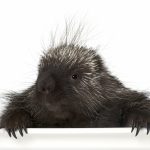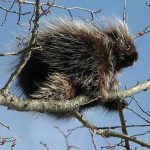
Contrary to popular belief though – a porcupine can’t ‘throw’ their spines. They don’t have any specific muscles or systems in place to literally spit out their spines. The spines, in fact, are hooked at the tip, so only if they make contact with the thing they are being threatened by (say a dog’s face or a human leg) will the spines come loose. It is similar to Velcro or those grass seeds that get hooked on your socks – you have to touch them.
A porcupine’s quills cover most of their body and they can have up to 30,000 quills at any one time. Some porcupines are completely covered in quills – others only have them from the shoulders back. All primed, sharp, and detachable.
Once grown to full size, the quills are no longer connected to the blood supply, so a mature quill falling out won’t hurt the porcupine or bleed. This is handy because often the porcupine can lose a few dozen quills at a time (into the face of an unsuspecting enemy).
Therefore, if you scare a porcupine that is up a tree – it can’t shoot its spines down in your direction in defense.
Do Porcupines Regrow Their Quills?
Luckily for porcupines – they will regrow their quills – otherwise, they would be unprotected for the rest of their lives (not such a good defensive strategy).
Porcupines are such a successful group of animals though – with over 30 different species – and this is due to their spines and how simple they are to grow.
Can Porcupines and Other Reptiles Coexist in the Same Habitat?
It is unlikely that ball pythons living with reptiles like porcupines would be a good idea. Porcupines are not reptiles, but rather mammals, and they are known for their quills as a defense mechanism. Allowing them to coexist with reptiles like ball pythons could lead to potential harm for both species.
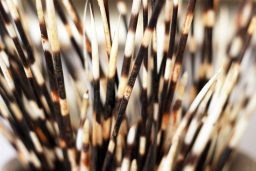
What are Porcupine Quills made of?
Basically, they are just hairs. They evolved from a special type of hair that, over time, became stiffened and thicker. Becoming known as quills – these hollow, pointed spines are made out of keratin – exactly the same thing as human hair, or cat fur. And just like human hair – they grow back in a constant cycle. So although the porcupines may lose 20 or more quills into the face of a hungry coyote – it won’t take them too long to grow a new set in their place.