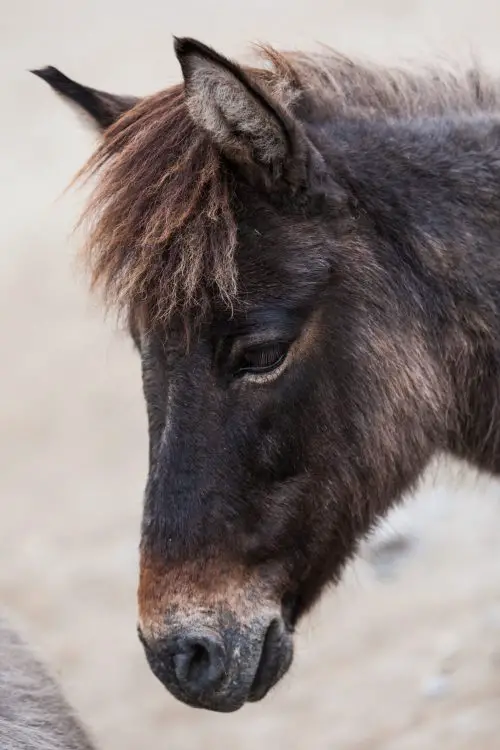
Donkeys are frequently misunderstood to be colorblind. They have better vision than humans due to their huge equine eyes. However, this does not imply that they can see all colors. We’ll go over whether Donkeys are color blind or not, as well as some intriguing facts about them.
Donkeys do not have color blindness. In contrast to humans, who have trichromatic vision, they have dichromatic vision, which means their eyes only contain two types of cone cells. This explains why horses can readily see some colors, particularly blue and green, but not red.
Humans with trichromatic vision can identify colors in three-wavelength areas. This enables us to see and identify all of the colors. Donkeys, on the other hand, can only discriminate between colors in two wavelength areas.
As a result, they, like humans with color blindness, are unable to recognize the color “red.” Even though they are not colorblind, there are some interesting aspects to their vision. For example, it’s still a concern about what they see, how they see, and how effectively their eyes see in the dark
Donkeys perceive things differently than people do; for example, they can see all around them without turning their heads. Apart from this, there are many other intriguing facts about them. That can only be described by taking a basic notion about the anatomy of the Donkey equine eye.
What Are The Donkey’s Blind Spots?
Donkeys have two blind spots, one right next to them and the other directly behind them. This is why it’s best to approach a Donkey from the side so that it can see and feel you coming. When approaching a horse from behind, you risk being kicked or wounded because the horse cannot see you when you’re immediately behind them.
Donkeys have a range of vision of nearly 180o from each eye (they have a range of vision of 350 degrees!). In comparison to a human’s forty-five-degree vision range, this is insanity). They have a practically complete vision of their flanks.
They are unable to see directly behind and in front of them. Donkeys can see and have visual acuity in front of them until they reach an area near their muzzle that they can’t see. Binocular vision refers to seeing with both eyes or viewing with two eyes. Because they only have one eye on each side, they have a monocular vision on their sides. Monocular vision refers to seeing or seeing with only one eye rather than either.
Can Donkeys See The Color Green?
Donkeys don’t require full-color vision in the same way that birds do, which rely on color for recognition and breeding techniques. Donkeys can recognize some hues, with yellow and blue being the greatest, but red being the worst. Donkeys could easily distinguish blue, yellow, and green from grey, but not red, according to one research.
Horses, like humans with red/green color blindness, have trouble distinguishing between red and green. Donkeys can still sense red objects, but they look like an intermediate color or even grey to them.
Are Pigs Colorblind Like Donkeys?
Pigs and hogs’ color perception has been a subject of curiosity for many animal enthusiasts. While donkeys are known to have limited color vision, the same cannot be said for pigs. Unlike donkeys, pigs have dichromatic vision, allowing them to see a limited range of colors. This difference in color perception adds to the unique characteristics of these two animals.
Do Donkeys Have Colored Blood?
Yes, there are animals with colored blood. For example, certain species of octopuses have blue blood due to the presence of copper-based hemocyanin. However, donkeys do not have colored blood. Their blood, like that of most mammals, is red due to the presence of iron-based hemoglobin.
What Colors Can Horses See?
Horses can easily discern colors like yellow, blue, and green, but they have a hard time recognizing tints of red or separating them from other colors like grey. Horses are afraid of yellow, prefer blue, and despise bright neon orange and yellow.
Horses have enormous eyes, and it turns out that they see the world differently than humans do. It’s crucial to understand how horses see the world to ride and train them. Horses can see humans and other things now, or how well they can see remains a mystery. Below are some facts that will help you understand how effectively horses can perceive or discern fine details?
Horses are noted for having a keen vision and being able to see well, although not as well as humans. This is because, although human vision is ideal at 20/20, horses’ eyesight appears to be in the range of 20/30 to 20/60. Humans can see details from 35 feet away, but horses must get closer to perceive them.
As a result, horses are unable to distinguish small details in the same way that people do. To observe the items, they must get 60 percent closer. A horse’s perception of a leap, barrel, or cluster of weeds is foggy, flat, and unclear even in bright light.